
Angelman Syndrome
 September 07, 2023
Angelman syndrome is a rare condition that affects your child’s speech, development and movement. Seizures are common. Children are usually very expressive — they may smile and laugh often or get excited easily. While this condition doesn’t have a cure, treatment options can help your child manage symptoms throughout their life.
What is Angelman syndrome?
Angelman syndrome is a rare genetic condition that affects your child’s development, speech, balance and movement. In some cases, it may cause seizures.
If your child has this condition, you’ll notice that they’re typically in a good mood more often than usual. They might smile frequently and laugh a lot. When they’re excited, they may make hand-flapping motions. Seeing your child happy and laughing might make you happy, too. It could feel strange to think that your child’s good mood could be a sign of a health condition.
Other signs and symptoms may appear as your child gets older. You may pick up on developmental delays, like not saying their first word before their first year. Also, seizures could start between their second and third birthdays.
This condition isn’t life-threatening and shouldn’t affect your child’s life expectancy, but it can be alarming for new parents. Your child will have some challenges with movement, speech and their development as they get older. But treatment options are available to help them manage these symptoms throughout their life.
How common is Angelman syndrome?
Angelman syndrome is rare. It affects approximately 1 in 12,000 to 20,000 people.
Symptoms and Causes
Symptoms of Angelman syndrome
Common symptoms of Angelman syndrome may include:
- Developmental delay
- Intellectual disability
- Speech challenges, ranging from not speaking at all (nonverbal) to only using a few words
- Walking difficulties, such as clumsiness and a wide-based walk (gait)
- Ataxia (difficulty with balance or coordination)
- Increased muscle tone (arms and legs) or decreased muscle tone (trunk)
- Seizures
Other symptoms may include:
- Difficulty feeding or sucking (infants)
- Sleep disturbances
- Spine curvature (scoliosis)
- Gastrointestinal issues like constipation or gastroesophageal reflux disorder (GERD)
- Eye issues, like involuntary eye movements (nystagmus), crossed eyes (strabismus) or sensitivity to light (photophobia)
- Skin discoloration (hypopigmentation)
These symptoms, or characteristics, vary from person to person and with age.
Facial features of Angelman syndrome
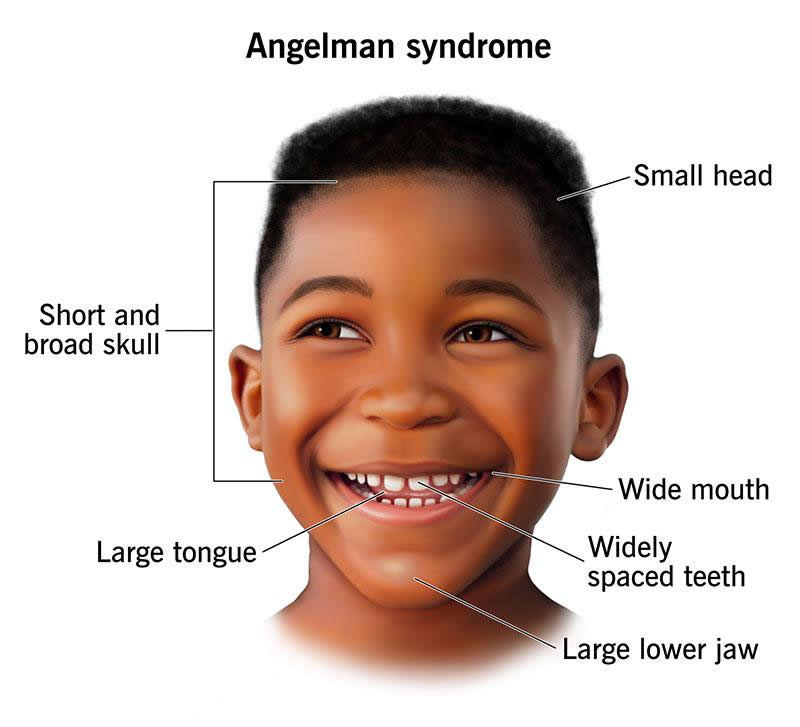
Common facial features of Angelman syndrome may include:
- A short and broad skull (brachycephaly)
- A large tongue (macroglossia)
- A small head (microcephaly)
- A big lower jaw (mandibular prognathia)
- Wide mouth
- Widely spaced teeth
These features may be more pronounced in adults with Angelman syndrome.
Angelman syndrome causes
A genetic variant of the UBE3A gene causes Angelman syndrome. This gene provides instructions to make an enzyme called ubiquitin protein ligase E3A, which regulates how your nervous system works. Any loss or damage to this gene causes symptoms of Angelman syndrome.
You inherit one copy of the UBE3A gene from each biological parent. Both copies of this gene are “turned on” (active) in many of your body’s tissues. But in certain areas of your brain, only the copy inherited from your birthing parent (maternal copy) is active. If the maternal copy of the UBE3A gene is lost or damaged for any reason, you’ll have no active copies of the gene in some parts of your brain. This can affect how your nervous system functions.
Some cases of Angelman syndrome are the result of a yet-to-be-identified genetic variant that isn’t the UBE3A gene.
Most cases aren’t inherited and happen randomly, without any history of the condition in your biological family.
Diagnosis and Tests
How doctors diagnose Angelman syndrome
The characteristic symptoms of Angelman syndrome aren't usually apparent at birth. Healthcare providers typically diagnose it in children between one and four years of age. But providers can sometimes identify the condition during pregnancy.
Noninvasive prenatal screening (NIPS) may diagnose Angelman syndrome before birth. NIPS is a method of determining the risk that your baby will be born with certain genetic conditions. This testing analyzes small fragments of DNA that are circulating in a pregnant person’s blood.
Your provider will usually diagnose Angelman syndrome if your child misses developmental milestones for their age. Examples of missed developmental milestones include not saying their first words or not taking their first steps as expected. Your child’s provider will also look for common symptoms or characteristics of the condition.
Testing confirms a diagnosis. Your child’s provider may offer genetic testing that identifies changes to the UBE3A gene. Other types of tests may be necessary to rule out conditions with similar symptoms.
Can Angelman syndrome be misdiagnosed?
In some cases, a misdiagnosis is possible because Angelman syndrome symptoms closely resemble those of other conditions like:
- Autism spectrum disorder
- Cerebral palsy
- Christianson syndrome
- Mowat-Wilson syndrome
- Phelan-McDermid syndrome
- Pitt-Hopkins syndrome
- Prader-Willi syndrome
Genetic testing and other types of testing are very important to make an accurate diagnosis.
Management and Treatment
How is Angelman syndrome treated?
There’s currently no cure for Angelman syndrome. But treatment is available to help your child manage symptoms. This may include:
- Antiseizure medications
- Communication aids and speech therapy, such as learning sign language, gesturing and using special communication devices
- Early intervention and educational resources to help your child meet developmental milestones and reach academic goals
- Physical therapy to help with balance, coordination and walking difficulties
- Occupational therapy to help your child gain independence and perform everyday tasks
- Using back, ankle or foot braces for support
- Modified feeding methods for infants, like using special nipples
- Following good sleep hygiene and setting a regular bedtime routine
- Taking medications to help food move through your child’s gastrointestinal tract
Your child’s provider will recommend treatment options specific to your child’s symptoms and needs. Treatment is individualized for each person.
How can I take care of my child with Angelman syndrome?
To help take care of your child with Angelman syndrome, follow their healthcare provider’s instructions. This should include:
- Giving any medications as prescribed
- Getting developmental assessments as recommended
- Participating in physical, occupational and speech therapies
- Going to all follow-up medical visits
Children with Angelman syndrome will likely need help with daily tasks throughout their lives. Your child’s care team can answer questions and offer support. They also might be able to recommend a local or online support group.
When should I take my child to see a healthcare provider?
If your child has Angelman syndrome, they’ll need to see their healthcare team regularly. This is to make sure their treatment and therapies are working. Let their provider know if you notice new or worsening symptoms. Visit the emergency room if your child has a seizure for the first time.
What questions should I ask my child’s healthcare provider?
If your child has Angelman syndrome, it may be helpful to ask their healthcare provider the following questions:
- Which treatments will be best for managing my child’s symptoms?
- How can I help my child communicate better?
- Should I have genetic testing or genetic counseling if I plan on having more biological children?
- How can I best plan for the support my child will need in the future?
- Can you recommend a support group?
Outlook / Prognosis
What is the life expectancy of someone with Angelman syndrome?
Many people diagnosed with Angelman syndrome have a typical life expectancy. This means that having Angelman syndrome doesn’t mean someone will die sooner than someone without it. The severity of symptoms varies for each person. Complications from severe seizures and injuries after falls may be life-threatening. Your child’s care team will offer treatments to keep your child safe to prevent these outcomes.
What’s the outlook for Angelman syndrome?
There are many factors that your child’s healthcare provider will consider when evaluating your child’s outlook. You can expect that your child will have some mobility, speech and developmental delays as they grow. But your child will still be able to participate in activities, play and learn with other kids their age.
Some adults can live partly on their own, with helpers coming to their home when needed. Others may need more support in assisted living or full-time care facilities.
Prevention
Can Angelman syndrome be prevented?
Angelman syndrome can’t be prevented because it happens due to random genetic changes during fetal development. In most cases, this happens without a known cause.
It’s rare, but some people inherit this condition. If you plan on having a biological child, talk with your healthcare provider about genetic counseling to understand your risk of having a child with a genetic condition or a condition that can be caused by an inherited genetic variant.
A note from Wockr
You might feel stressed or overwhelmed to learn that your child’s frequent smile and laughter are actually characteristics of an underlying genetic condition. But your little bundle of joy will still be smiling and giggling after an Angelman syndrome diagnosis. It’s important to follow up with their providers regularly to make sure your child is on track to meet developmental milestones for their age at a pace that’s right for their needs. Your child’s care team will be with you every step of the way. Don’t hesitate to ask questions to learn more about the condition and what you can expect for their future.