
Hemifacial Spasm (Face Twitching)
 August 30, 2023
Hemifacial spasm causes frequent muscle twitches on one side of your face. These spasms tend to get worse and involve more muscles in your face over time. Face twitching is treatable. Most people opt for regular botulinum toxin injections to keep the spasms at bay.
What Is Hemifacial Spasm?
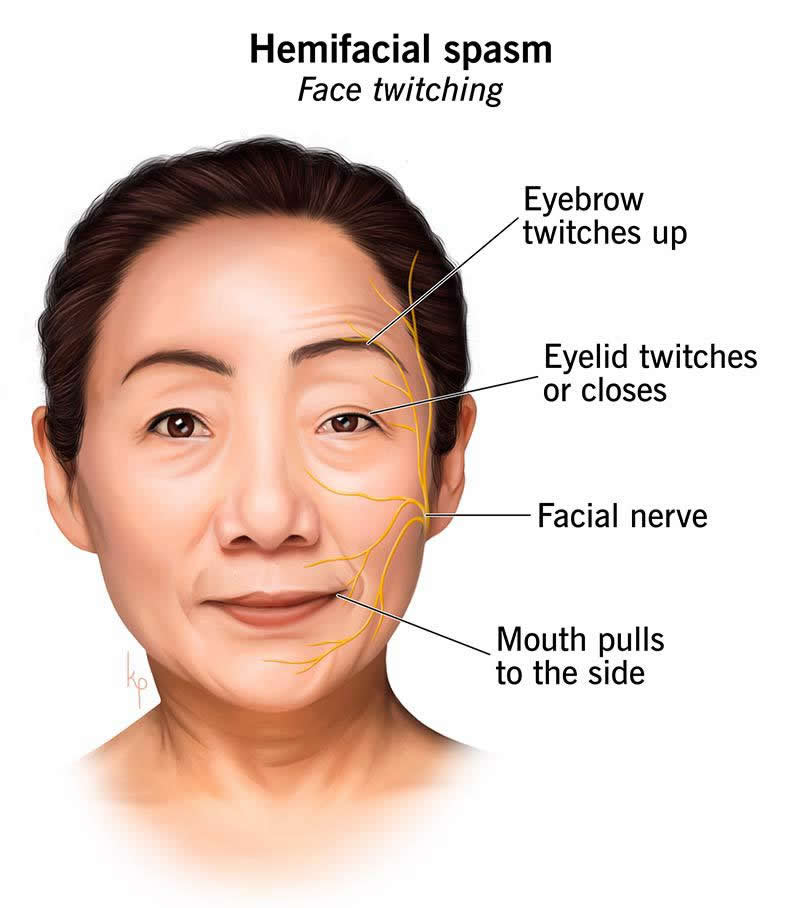
Hemifacial spasm (HFS or face twitching) is a neurological condition in which you have frequent involuntary muscle twitches on one side of your face only. The muscle twitches tend to get worse over time. “Hemifacial” means “half of the face,” and a “spasm” is a muscle twitch.
HFS usually begins in adulthood, sometime around your 40s through 60s.
Healthcare providers consider face twitching to be a type of peripheral movement disorder or a condition that affects your peripheral nervous system. This system sends information from your senses to your brain.
Hemifacial spasm is rare. Females are twice as likely to develop HFS compared to males.
Another name for face twitching is involuntary facial movements.
Types of hemifacial spasm
There are two types of face twitching based on how symptoms get worse (progress) over time:
- Primary hemifacial spasm: It may take several months or years before the spasms affect your lower facial muscles.
- Secondary hemifacial spasm: The upper and lower facial spasms tend to develop at the same time. At first, they come and go, but then become more frequent.
Symptoms and Causes
Symptoms of hemifacial spasm
The main symptom of hemifacial spasm is muscle twitching on one side of your face. It’s involuntary, meaning you don’t have control over it. HFS tends to affect the left side of your face more than the right side. Rarely, it can cause twitches on both sides of your face.
The first symptom of HFS is usually twitching of your eyelid muscle that comes and goes. Symptoms can progress to:
- Involuntary eye closure
- Spasms that raise your eyebrow
- Spasms in your lower face, which may pull your mouth to one side
- Spasms that affect all the muscles on one side of your face. These spasms may be almost constant
The spasms of face twitching typically don’t hurt, but they may make you feel self-conscious. Stress, fatigue, eating and anxiety tend to make the symptoms worse. The spasms can continue while you sleep, leading to sleeping issues and insomnia.
Other symptoms of HFS
Some people experience additional symptoms of HFS, including:
- A clicking sound in your ear
- Ear pain
- Hearing loss (secondary hemifacial spasm)
Hemifacial spasm causes
The main cause of hemifacial spasm is long-term (chronic) irritation of one of your facial nerves (seventh cranial nerve). But several underlying conditions and factors can lead to this irritation.
You have two facial nerves — one for each side of your face. Your facial nerve arises from your brainstem and branches out across one side of your face to your temple, cheek, nose, mouth, chin and upper neck. This nerve is responsible for:
- Movement of your facial muscles that are responsible for facial expression
- Parasympathetic function of the salivary glands in your mouth and the lacrimal gland in the corner of your eye
- Sensory function of the front two-thirds of your tongue
Causes may differ for each type of face twitching.
Primary hemifacial spasm causes
Primary hemifacial spasm happens when an abnormally positioned (aberrant) blood vessel squeezes (compresses ) the nerve root of your facial nerve. The compression causes the protective covering (myelin sheath) of nerve axons to break down. This leads to nerve-signaling “misfires” and muscle twitching.
This is the most common cause of hemifacial spasm.
Secondary hemifacial spasm causes
Secondary hemifacial spasm happens from an underlying condition or issue that irritates your facial nerve. Underlying conditions could include:
- Trauma or injury near your facial nerve
- Bell’s palsy
- Brainstemlesions (damage), like from multiple sclerosis or stroke
- Arteriovenous issues, like brain aneurysms, arteriovenous fistula and angiomas (noncancerous growths that consist of small blood vessels)
- Ear issues, like ear infections (otitis media), mastoiditis and cholesteatoma
- Parotid gland tumors
- Chiari malformation and other structural issues of the lower back part of your skull (posterior cranial fossa)
Diagnosis and Tests
How doctors diagnose hemifacial spasm
If you have symptoms of hemifacial spasm, a healthcare provider will do a physical exam and a neurological exam.
They’ll likely recommend a brain MRI to rule out other possible causes of your symptoms and/or to find the underlying cause of HFS. MRI can usually detect the abnormal artery that’s pressing against your nerve in cases of primary hemifacial spasm.
The spasms can look like other types of facial involuntary movements, like blepharospasm or complex partial motor seizures. If your provider can’t distinguish the type of movement, they may recommend electromyography (EMG) testing.
Management and Treatment
How is hemifacial spasm treated?
The main goal of treatment for face twitching is to reduce the number and intensity of facial spasms. Treatment options depend on the underlying cause and severity of the condition. They include:
- Botulinum toxin type A (Botox®) injections
- Oral medications
- Surgery
Botox injections for HFS
Botulinum toxin injections are typically the first-line treatment for HFS due to their effectiveness and minimal side effects. The injections work to temporarily gently weaken facial muscles that experience spasms.
People usually experience symptom improvement three to six days after the injections. The effects typically last for three to four months and then wear off. So, you’ll need ongoing injections to keep the spasms at bay.
You may have the following side effects after an injection:
- Eye irritation
- Eyelid drooping
- Temporary facial weakness
Oral medications for HFS
Oral medications (pills) are a treatment option for people who don’t want Botox injections and aren’t able to have surgery. The types of medications healthcare providers may prescribe include:
- Anticonvulsants, like carbamazepine or gabapentin
- Benzodiazepines, like clonazepam
- Muscle relaxants, like baclofen
- Tricyclic antidepressants
- Antipsychotics, like haloperidol
These medications can help minimize spasms, but they don’t work for everyone. They can also have serious side effects, like slowed activity of your nervous system (sedation) and fatigue, especially with long-term use.
Hemifacial spasm surgery
Surgery is the only permanent treatment solution for HFS. But healthcare providers typically only recommend it for severe cases of HFS and when botulinum toxin injections don’t work.
The surgical procedure most providers use is called microvascular decompression. It involves releasing your facial nerve from the abnormally positioned blood vessel that’s compressing it.
If the surgery is successful, you’ll no longer have HFS. Most people have a positive success rate following this procedure.
As with any surgery, there are risks to microvascular decompression. It can lead to certain complications, like:
- Anesthesia reactions
- On-and-off or permanent facial nerve paralysis
- Hearing loss
- Cerebrospinal (CSF) leakage
When should I see my healthcare provider?
If you’re receiving injections or taking oral medication for face twitching, you’ll need to see your healthcare provider regularly to make sure the treatment is working.
Contact your provider if you experience side effects of treatment or if your symptoms get worse.
What questions should I ask my healthcare provider about hemifacial spasm?
It may be helpful to ask your healthcare provider the following questions about face twitching:
- What caused this?
- What are my treatment options?
- How often would I need to get botulinum toxin injections?
- What should I do if my symptoms get worse?
- Are there any home remedies that help with symptoms?
Outlook / Prognosis
Can hemifacial spasm go away on its own?
There isn’t a cure for hemifacial spasms. It’s usually a long-term (chronic) condition. But about 10% of cases go away (resolve) on their own. Healthcare providers aren’t sure how or why this happens.
Is hemifacial spasm dangerous?
Hemifacial spasm itself isn’t harmful to your physical health. But some of the possible underlying causes — like brainstem damage or tumors — could be.
In addition, you may experience complications of HFS, like:
- Sleep issues
- Mental health concerns, like social isolation, anxiety and depression
- Prolonged involuntary eye closure, which could cause safety issues (like when driving)
For all these reasons, it’s important to see a provider if you develop symptoms of facial spasms — and seek treatment.
A note from Wockr
Hemifacial spasm (HFS) can be a very annoying and disruptive condition — no one likes to feel out of control of their body. But the good news is that there are effective treatment options, like injections or medications. If you develop frequent facial twitching that’s getting worse, be sure to see a healthcare provider. They can do exams and tests to find the underlying cause and offer a treatment plan that’s best for you.