
Annular Pancreas
 July 02, 2025
Annular pancreas is a rare disorder that happens when a ring of pancreatic tissue wraps around your duodenum. It’s a congenital (present at birth) condition that may not cause symptoms. Symptoms in babies include bile in vomit and difficulty feeding. Symptoms in adults are nausea and vomiting. Complications include pancreatitis or pancreatic cancer.
Overview
What is annular pancreas?
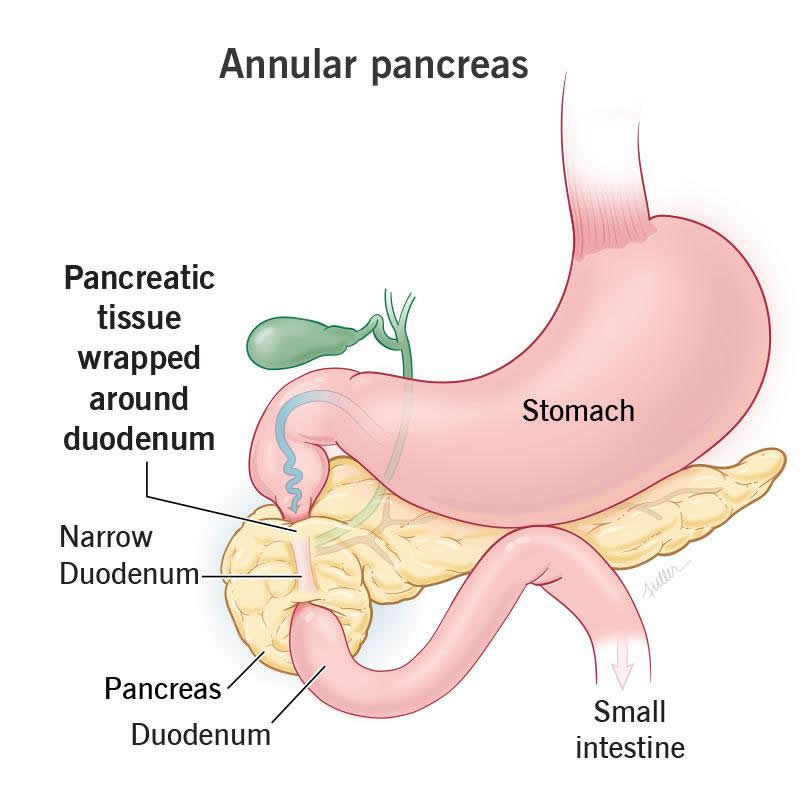
Annular pancreas is when part of your pancreas (pancreatic tissue) wraps around your duodenum. Your duodenum is part of your small intestine.
In annular pancreas, there’s a ring or collar of pancreatic tissue squeezing your duodenum. (Annular is a medical term for something that forms a ring.) This makes your duodenum narrow (constrict) so food and fluid can’t move from your stomach to your small intestine.
This is a congenital condition, meaning it’s present from birth. Healthcare providers often diagnose and treat annular pancreas right after birth. But the condition may not cause symptoms. Adults often learn they have annular pancreas because they have imaging tests for another reason (incidental finding). You may learn you have annular pancreas because you develop certain conditions that affect your biliary system.
How common is annular pancreas?
Annular pancreas is rare, but experts aren’t sure exactly how often this condition happens. For example, one analysis of adults who had abdominal imaging tests found that about 3 in 100,000 people had annular pancreas. The condition affects 1 in 20,000 newborn babies.
Symptoms and Causes
What are the symptoms of annular pancreas?
Annular pancreas symptoms are different in newborn babies than in adults.
Symptoms in newborn babies
Your baby may have:
- Crying that feeding doesn’t soothe
- Bloated belly
- Issues nursing or taking a bottle
- Signs that they’re not passing meconium
- Vomit that’s green or yellow (bile in vomit)
Symptoms in adults
Often, annular pancreas symptoms in adults don’t start until you’re in your 30s or even up through your 60s. Symptoms in adults include:
- Abdominal pain or cramps that you feel in your upper and middle abdomen
- Feeling full after eating small amounts of food
- Nausea and vomiting
What causes annular pancreas?
Annular pancreas happens during fetal development as a fetus’s pancreas begins to form. Experts don’t know the exact cause. Certain conditions increase the risk that you or your baby will have annular pancreas. Those include:
- Anal rectal malformations like imperforate anus
- Down syndrome
- Duodenal atresia
- Esophageal atresia
- Heart abnormalities
- Meckel’s diverticulum
- Pancreas divisum
What is the most common complication for annular pancreas?
Without treatment, annular pancreas may cause complications like:
- Bile duct obstruction
- Duodenal obstruction
- Jaundice
- Liver disease
- Pancreatitis
- Pancreatic cancer
- Peptic ulcer disease
Diagnosis and Tests
How do healthcare providers diagnose annular pancreas?
Imaging tests are the most common way that healthcare providers diagnose annular pancreas. Tests vary depending on age. For example:
- Prenatal ultrasoundsmay detect polyhydramnios. This is too much amniotic fluid in your uterus. It can happen if annular pancreas blocks a fetus’s duodenum.
- AbdominalX-rays may detect annular pancreas in babies.
Imaging tests for adults may include:
- Endoscopic ultrasound (EUS)
- Endoscopic retrograde cholangiopancreatography (ERCP)
- Magnetic resonance cholangiopancreatography (MRCP)
Your healthcare provider may do other tests to rule out conditions that cause the same symptoms as annular pancreas.
Management and Treatment
What is the best treatment for annular pancreas?
The best treatment for annular pancreas depends on your situation. Adults may not need treatment unless the condition causes complications like pancreatitis. In general, however, providers recommend surgery.
There are different surgical treatments for annular pancreas. But they all involve creating new ways for food from your stomach to move through your small instetine. Surgery types are:
- Duodenoduodenostomy: Your surgeon makes an incision (cut) in your duodenum to divide it into two sections. Then, they connect the two sections of your duodenum. The new connection bypasses the section of your duodenum that annular pancreas affects.
- Duodenojejunostomy: This surgery involves taking a section of your duodenum that annular pancreas doesn’t affect. Your surgeon connects that part of your duodenum to your stomach.
- Gastrojejunostomy: This surgery doesn’t involve your duodenum. Instead, your surgeon connects a section of your jejunum (the middle part of your small intestine) to your stomach.
Outlook / Prognosis
Can you live with annular pancreas?
Yes, you can live with this condition. For example, the outlook is good for babies who have surgery for annular pancreas. The outlook for adults depends on complications that annular pancreas may cause. If you have annular pancreas, your healthcare provider is the best person to explain what you can expect.
Prevention
Can annular pancreas be prevented?
There’s no known way to prevent annular pancreas. The condition happens during fetal development. Experts aren’t sure why this happens.
Living With
When should I see my healthcare provider?
Often, adults can have annular pancreas without symptoms. If you have annular pancreas, contact your provider if you have changes in your body, like nausea and vomiting that don’t go away within a few days.
A note from Wockr
It can be unnerving to have a rare condition like annular pancreas. Double that feeling if your newborn baby has it. This condition is a bit of a medical mystery. It happens during fetal development, but experts don’t know the exact reason why that happens. They aren’t sure why some people live for years without symptoms. But they are certain that surgery can help. Knowing surgery is a solution may help you feel more confident about your newborn baby’s health or your own.