
Elastic Arteries
 March 02, 2023
Elastic arteries like your aorta and pulmonary artery are arteries that carry a large amount of blood away from your heart. Their high elastic content lets them handle the force of blood coming from your heart nearby. This is important because your heart switches between pumping and resting instead of sending blood in a steady flow.
Overview
What are elastic arteries?
Elastic arteries are a type of artery that’s flexible enough to keep blood flowing steadily. They can do this even though your heart pumps blood in bursts, alternating between pumping and resting.
Which arteries are elastic arteries?
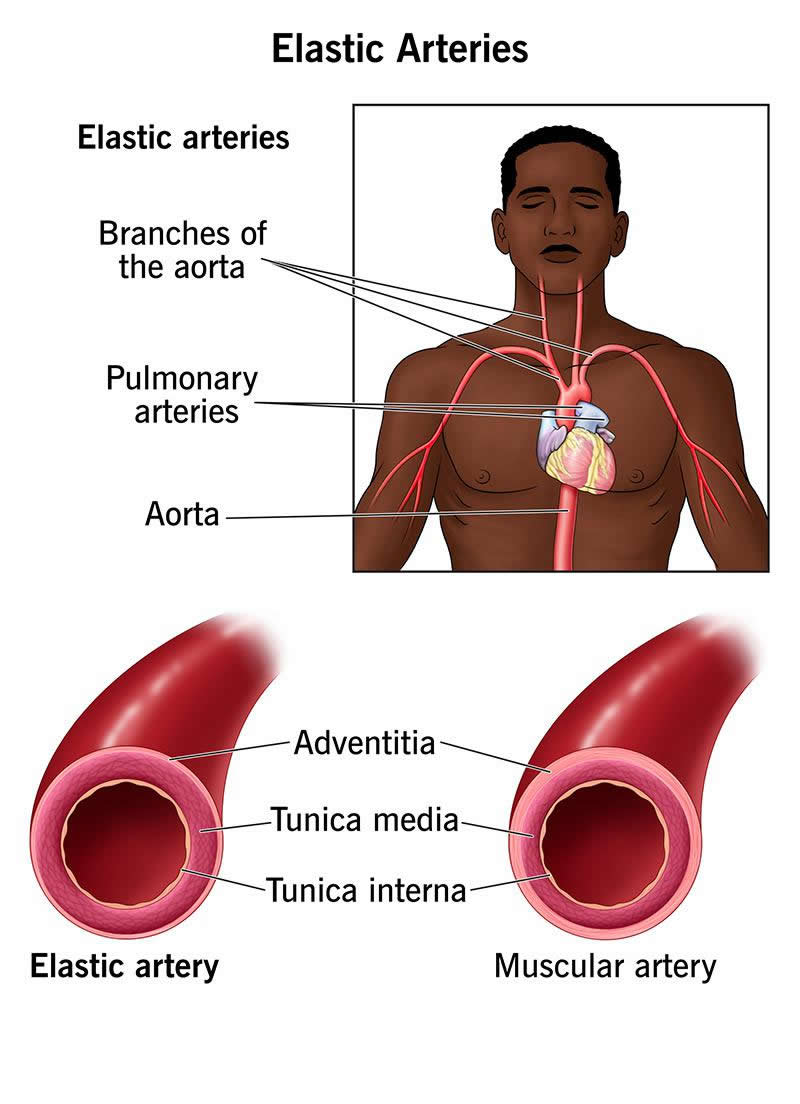
Elastic artery examples include your pulmonary arteries, aorta and the aorta’s branches. These arteries branch from your aorta:
- Brachiocephalic artery.
- Common carotid arteries.
- Subclavian arteries.
- Common iliac arteries.
Function
What do elastic arteries do?
Elastic arteries are vital to getting oxygen and nutrients to your body’s cells. They have to be able to handle the high pressure and volume of blood that your heart pumps. They’re like the big pipes that bring water to your neighborhood and send it to smaller pipes that go to your house. The smaller pipes are your other arteries that handle a smaller volume of blood.
Your pulmonary arteries are the only elastic arteries (or any type of artery) that carry oxygen-poor blood. Your pulmonary arteries’ job is to get that blood to your lungs, where it can pick up oxygen.
Anatomy
Where are elastic arteries found?
Elastic arteries are very close to your heart. Your aorta, your largest artery, sits right above your heart and runs behind and below it. Your aorta connects to your heart through an aortic valve on the left side of your heart. This valve lets oxygen-rich blood into your aorta so it can send it to your body.
Other elastic arteries branch off your aorta in your upper chest:
- Brachiocephalic artery coming off your aortic arch.
- Right and left subclavian arteries near your collarbones.
- Right and left common carotid arteries in your neck.
- Right and left common iliac arteries coming out of the lower part of your aorta (in your belly).
Your pulmonary arteries are right above your heart, as well. A pulmonary valve on the right side of your heart connects your pulmonary arteries to your heart so it can send oxygen-poor blood to your pulmonary arteries. Your pulmonary arteries take blood to your lungs, where your blood gets oxygen.
What are the parts of elastic arteries?
Like most blood vessels, elastic arteries have three layers:
- An outer layer (adventitia) that gives it structure.
- A middle layer (tunica media) that contains elastic and muscular tissue. (Elastic arteries have more elastic than muscle tissue in this layer.)
- An inner layer (tunica intima) that’s smooth so blood can flow easily.
What do elastic arteries look like?
Elastic arteries are large, cylinder-shaped tubes that are hollow in the middle to allow blood to flow through them. Your aorta has a different shape than the others. It looks like a large candy cane with legs.
How big are elastic arteries?
The biggest elastic artery, your aorta, has an internal diameter of 2.5 centimeters (nearly 1 inch). Your aorta’s wall is 2 millimeters (.07 inches) thick.
What are elastic arteries made of?
Elastic arteries have small fibers of muscle and collagen.
Conditions and Disorders
What are the common conditions and disorders that affect elastic arteries?
Common conditions that affect elastic arteries include:
- Aneurysm (bulging) or dissection (tearing).
- Issues with your aortic or pulmonary valve, such as leaks or stiffness.
- Congenital (since birth) heart diseases that affect your aorta or pulmonary arteries.
- Vasculitis (inflammation).
- High blood pressure.
- Atherosclerosis.
- Blood clots.
- Heart failure.
What are the common signs or symptoms of elastic artery conditions?
Symptoms of elastic artery conditions include:
- Fast heartbeat.
- Lightheadedness.
- Headache.
- Fatigue.
- Chest pain.
- Heart palpitations.
- Shortness of breath.
- Leg cramps during a walk.
What are the common tests to check the health of elastic arteries?
Healthcare providers can use various tests to check the health of your elastic arteries, such as:
- Blood tests.
- Angiogram.
- Magnetic resonance imaging (MRI).
- Computed tomography (CT).
- Ultrasound.
- Echocardiogram.
- Chest X-ray.
- Electrocardiogram (EKG).
- Cardiac catheterization.
What are the common treatments for elastic arteries?
Treatments for elastic artery conditions include:
- Medications.
- Surgery.
Care
Simple lifestyle changes/tips to keep elastic arteries healthy
Habits that are good for your heart and blood vessels are good for your elastic arteries. These good habits include:
- Eating low-fat foods that are low in salt.
- Exercising regularly.
- Managing high blood pressure.
- Managing high cholesterol.
- Avoiding tobacco products.
- Managing your stress level.
Additional Common Questions
What is the difference between elastic arteries and muscular arteries?
Elastic arteries have more elastic tissue in their middle layer, while muscular arteries have more muscular tissue there.
A note from Wockr
Your elastic arteries play an important role in your body. They make sure you get oxygen-rich blood to all of your body’s cells. That’s why taking care of them is an investment in your health. Keep them healthy and they’ll keep delivering the blood your body needs.