
Lingual Artery
 June 12, 2023
Your lingual artery takes blood from your carotid artery in your neck to parts of your mouth. It runs under your jaw and ends at the tip of your tongue. Four branches of your lingual artery carry blood to specific areas in your mouth, including your tongue and several muscles.
Overview
What is the lingual artery?
Your lingual artery is a blood vessel that brings blood from your neck to several parts of your mouth. You have one lingual artery on either side of your jaw. This blood supply is important to the muscles and tissues you use when you eat or talk.
Function
What is the function of the lingual artery?
The lingual artery supplies blood to parts of your mouth. These include your:
- Tongue.
- Muscles in your mouth.
- Floor of your mouth.
- Roof of your mouth (palate).
- Tonsils.
- Epiglottis.
- Salivary glands (one of them).
- Jaw.
Anatomy
Where is the lingual artery found?
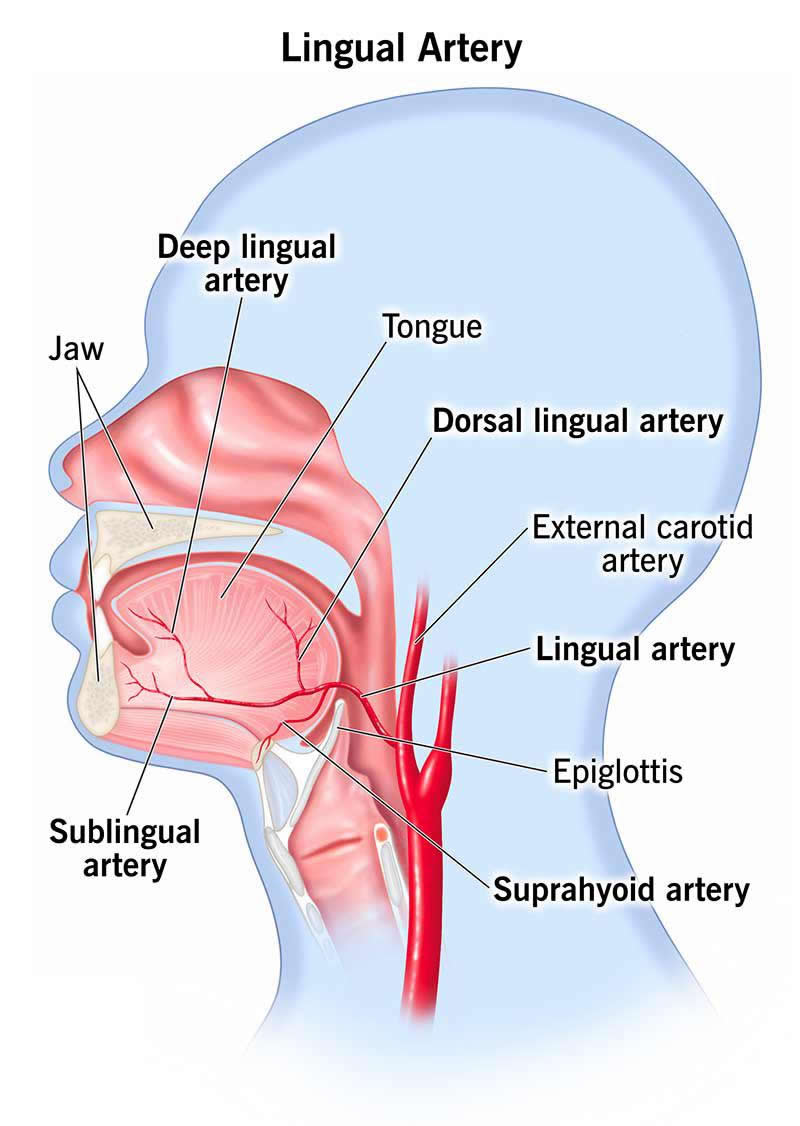
Your lingual artery branches off from your external carotid artery, which runs up and down your neck. Starting in your neck, your lingual artery goes forward and under your jaw and then under your tongue. Your lingual artery ends at the tip of your tongue.
Some of your lingual artery branches from the left and right sides of your mouth connect to each other.
What are the parts of the lingual artery?
Your lingual artery has three parts:
- The first part is closest to your carotid artery, where your lingual artery starts.
- The second part lies deep under your jaw, going forward.
- The third part runs up under your tongue.
What are the lingual artery branches?
The branches of your lingual artery are:
- Suprahyoid artery, which sends blood to several muscles in the front of your neck.
- Dorsal lingual artery, which sends blood to your epiglottis, the roof of your mouth and other areas.
- Sublingual artery, which supplies blood to your tongue muscle, one of your salivary glands and other areas.
- Deep lingual artery or ranine artery, which sends blood to the tip of your tongue.
What does the lingual artery look like?
Your lingual artery is about 2 to 5 millimeters (.07 to .19 inches) in diameter. It’s almost as long as your tongue.
Lingual artery anatomy can vary in many people. Instead of starting from its own separate branch of the external carotid artery, it can branch off with one or more other nearby arteries. Researchers have seen many variations in where your lingual artery can go in relation to nearby muscles after branching off.
Conditions and Disorders
What are the common conditions and disorders that affect the lingual artery?
If you have surgery for an abnormal growth, dysphagia (trouble swallowing) or sleep apnea, your surgeon will be working near your lingual artery. They’ll need to be careful to avoid damaging it because that could cause a loss of tissue in your tongue or a life-threatening loss of blood.
Other things that can damage your lingual artery include:
- Radiation therapy for head or neck cancer.
- Pseudoaneurysm, injury to your artery wall.
- Temporal arteritis (giant cell arteritis), artery inflammation.
- Tongue cancer.
- Facial injury.
Common signs or symptoms of the lingual artery conditions
Signs or symptoms of issues with your lingual artery include:
- Lingual artery narrowing can happen after radiation.
- Nosebleed-like bleeding could actually be a sign of a pseudoaneurysm.
- Pain and swelling can be signs of temporal arteritis.
- Severe bleeding from your lingual artery can happen with tongue cancer.
- Bleeding can happen after a facial injury.
Common tests to check the health of the lingual artery
Healthcare providers can use these tests to check your lingual artery:
- Ultrasound, which uses sound waves.
- Computed tomography (CT) angiogram, which uses X-rays and a computer.
- Magnetic resonance angiogram (MRA), which uses an MRI.
Common treatments for the lingual artery
Treatments for your lingual artery may include:
- A statin to keep your artery from getting too narrow after radiation.
- A minor operation for a pseudoaneurysm.
- Corticosteroid medication for temporal arteritis.
- Surgery for tongue cancer or a facial injury.
Care
Simple lifestyle changes/tips to keep the lingual artery healthy
The same things you do to keep all of your blood vessels healthy will help your lingual artery, too, like:
- Exercising on most days.
- Avoiding all tobacco products.
- Eating foods low in saturated fats.
- Cutting down on how much salt you eat.
- Limiting the number of alcoholic beverages you drink.
Additional Common Questions
What happens if the lingual artery is damaged?
Damage to your lingual artery can cause severe bleeding. It could also cause you to lose tissue in your tongue.
A note from Wockr
Your mouth needs blood and oxygen from your lingual artery to function. Eating healthy foods and having other healthy habits can help all of your arteries keep working well. Seeing your healthcare provider regularly allows them to find issues early, when they’re easier to treat.