
Peritubular Capillaries
 October 25, 2021
Peritubular capillaries are tiny blood vessels in your kidneys. They filter wastes from your blood, which leave your body through your pee. Peritubular capillaries also reabsorb nutrients that your body needs to work properly, such as minerals. You have millions of these capillaries inside your kidneys’ filtering units.
Overview
What are peritubular capillaries?
Peritubular capillaries (PER-uh-TOO-byoo-ler KAP-uh-ler-eez) are tiny blood vessels in your kidneys. They play an essential role in your urinary system: They deliver wastes that you eventually get rid of when you urinate (pee). They also reabsorb nutrients that your body needs.
“Peritubular” means it’s around small tubes (tubules).
Function
What do peritubular capillaries do?
Peritubular capillaries help your urinary system get rid of wastes, including:
- Urea (a nitrogen waste that develops when your body breaks down proteins).
- Creatinine (a waste product from your muscles).
- Acids.
They move cell wastes and excess water through your kidney’s filtering units (nephrons). The wastes travel into your urinary bladder and leave your body through your pee.
Peritubular capillaries also reabsorb substances your body needs to work properly, including:
- Amino acids.
- Minerals.
- Sugar in your blood (glucose).
They supply blood and oxygen to the cells in a system of tubes in your kidneys, as well.
What substances are secreted from the peritubular capillaries?
Your peritubular capillaries secrete waste products and excess water.
Anatomy
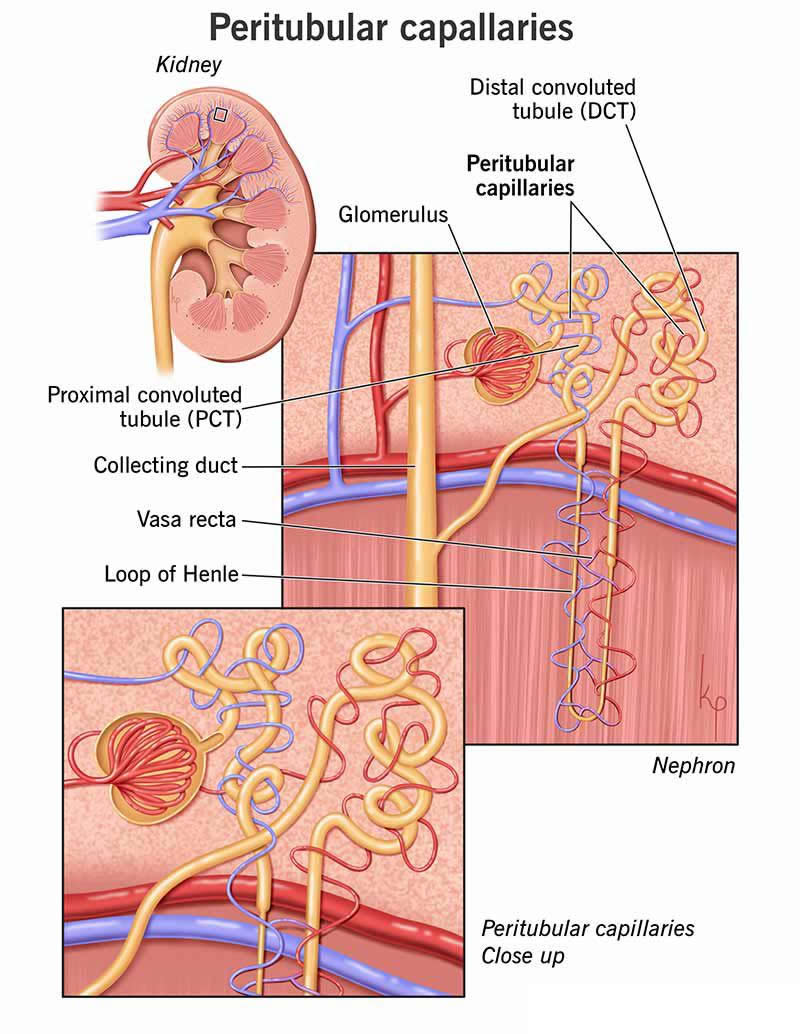
Where are the peritubular capillaries located?
Each of your kidneys contains about 1 million nephrons. A nephron is a single kidney filtering unit. Nephrons include a filter (glomerulus, plural glomeruli), and a system of different types of tubes. The tubes reabsorb nutrients and water that the glomerulus filters out.
What do the peritubular capillaries look like?
Peritubular capillaries are so small that you can’t see them with the naked eye. You need a microscope to see them. They’re a fenestrated blood vessel. That means each capillary has tiny openings (pores).
The pores make it easier for fluids and substances such as minerals and waste products to move back and forth between the capillaries and the tissues that surround them. Each pore has a thin tissue (membrane) that opens and closes, allowing larger molecules to pass through easily.
What blood vessel receives blood from the peritubular capillaries?
Blood enters your kidneys through your renal arteries. Your renal artery is a large blood vessel that branches into smaller blood vessels (afferent arterioles), which lead to the nephrons. The glomeruli in your nephrons filter your blood, the blood passes through different arterioles (efferent arterioles) and into your peritubular capillaries. When blood leaves your peritubular capillaries, it flows through veins that gradually get larger until it exits your body through your renal vein.
Conditions and Disorders
What are the common conditions and disorders that affect the peritubular capillaries?
Certain health conditions and diseases, including inflammation and scarring, can damage your peritubular capillaries. This damage can lead to a loss in density in your capillaries (peritubular capillary rarefaction). Density is the amount of mass an object has compared to its volume. The loss in density affects how your capillaries work.
Damaged peritubular capillaries aren’t very good at repairing themselves. Because they can’t work as they should, peritubular capillary rarefaction contributes to chronic kidney disease (CKD) and high blood pressure (hypertension). These conditions are common. In the U.S., nearly half of all adults have high blood pressure, and about 15% of adults have some type of CKD. Without treatment, kidney disease may lead to kidney failure.
Kidney disease can result from or occur alongside several conditions, including:
- Glomerular diseases, including glomerulonephritis.
- Kidney infection.
- Obstruction in your ureter (ureteral obstruction).
What are the common signs of peritubular capillary conditions?
You may not have any symptoms even if there’s something wrong with your peritubular capillaries. But if you do, common signs include:
- Flank pain.
- Fever.
- Nausea and vomiting.
- Feeling very tired (fatigue).
- Changes to your peeing habits, including peeing more than usual (frequent urination), trouble peeing, blood in your pee (hematuria) or pain when you pee (dysuria).
- Cloudy pee.
- Swelling (edema), especially in your feet or ankles.
- Urinary tract infections (UTIs) that go away and come back (recurrent UTIs).
What are the common tests to check the health of the peritubular capillaries?
A healthcare provider may recommend the following tests if they suspect there’s something wrong with your peritubular capillaries:
Kidney function tests
Kidney function tests include:
- Urine test (urinalysis).
- Blood tests, including a blood urea nitrogen (BUN) test, creatinine clearance test and estimated glomerular filtration rate (eGFR).
Imaging tests
Noninvasive imaging tests may include:
- CT scan (computed tomography scan).
- MRI (magnetic resonance imaging).
- Kidney (renal) ultrasound.
Care
How can I keep my peritubular capillaries healthy?
You may not always be able to prevent peritubular capillary damage. But you can lower your risk of kidney problems and other health conditions by focusing on your overall health. This includes:
- Eating healthy foods every day and drinking water when you’re thirsty.
- Managing diabetes, high blood pressure and other long-lasting (chronic) health conditions.
- Maintaining a healthy weight for you.
- Quitting smoking. Smoking and other tobacco products damage your blood vessels and cause vascular disease (vasculopathy).
A note from Wockr
Your kidneys have a lot of little parts that work together to keep you healthy. Peritubular capillaries play an essential role in helping your urinary system filter waste from your blood. They also reabsorb useful nutrients that support your health. You have millions of peritubular capillaries in your kidneys. To keep these and other capillaries working as they should, it’s a good idea to be mindful of your overall health. Drink plenty of water, follow nutritious eating plans, see your provider for regular checkups and maintain a healthy weight for you.