
What Is Scaffolding?
 May 15, 2025
This child development strategy is all about meeting your child where they are
Scaffolding is a technique for teaching new skills that’s based on three key principles:
- Individualization. One size does not fit all in learning. When scaffolding, you build on your kid’s existing skill sets and move forward at their pace, not yours.
- Active learning. Your child is involved in (and empowered by) the learning process. They’re asking questions, solving problems and demonstrating their understanding.
- Support and guidance. You create a safe environment to learn and make mistakes. As your child’s ability grows, you slowly reduce your support. You’re done when they’re able to demonstrate their new skill all by themself.
We’re focusing on children. But scaffolding’s a great strategy to teach anyone a new skill. Teachers and psychologists practice scaffolding. So do parents, doctors, programmers, project managers and more.
Pediatric neuropsychologist Lindsay Katz, PsyD, breaks down the benefits of scaffolding for child development.
How does scaffolding work?
Instructional scaffolding works a lot like physical scaffolding (the temporary structures that support construction workers while they build tall buildings).
To scaffold properly, you need to identify what psychologists call the “zone of proximal development.” Developed by psychologist Lev Vygotsky, the zone of proximal development is the gap between a task being so hard you can’t do it even if someone helps you and a task being easy enough that you can do it alone.
When you scaffold, you’re not focusing on hitting a specific milestone. You’re meeting your kid in their unique zone of proximal development and helping them grow new skills.
For example, your 2-year-old may be singing their ABCs like a champ. But that doesn’t mean they can write out the alphabet, even with you helping. Teaching them to identify letters with flashcards is a developmentally appropriate skill you can scaffold.
Once you know where you’re starting from, you break down the skill or task and teach it step by step, providing lots of support and guidance along the way. You don’t move forward until your child can perform the previous step by themself. You’re building on existing skills and adjusting the level of support (and difficulty) over time. Your child has mastered the skill or task when they can perform the whole thing, beginning to end, without scaffolding. (That is, without your help.)
Scaffolding techniques
So, what exactly does scaffolding look like? Dr. Katz says it depends on your kid’s age and developmental level. But common approaches include:
- Giving demonstrations
- Asking leading questions
- Offering prompts, hints or suggestions
- Breaking big tasks down into smaller, more manageable ones
- Feeding your child some — but not all — of the answers
- Creating templates or checklists
- Encouraging your child to mirror or mimic you
- Offering specific praise and feedback
So, now you have a basic idea of what scaffolding is. But it’s equally important to know what it isn’t.
“Scaffolding isn’t providing answers or just doing the task yourself,” Dr. Katz clarifies. “The assistance you offer should be aimed at developing the child’s skillset so they can eventually transition to independence.” For example, if your toddler can’t get the puzzle piece to fit, don’t just put the piece in for them. Turn it, hand it back to them and let them add it to the puzzle themself.
Example of scaffolding
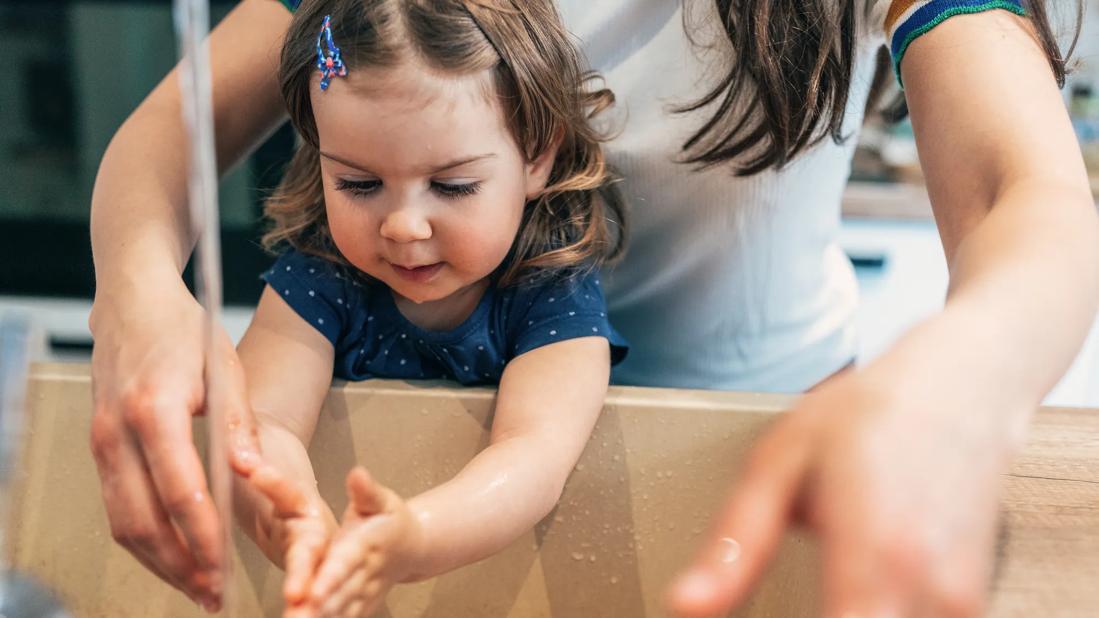
It makes sense in the abstract. But what does scaffolding a task actually look like? Dr. Katz often uses the example of teaching a child to wash their hands.
“Once you know how to do something, it becomes automatic,” she explains. “You don’t think about all the steps that go into activities like washing your hands. But if someone hasn’t done it before, it’s pretty complex.”
To teach this important life skill using scaffolding, you:
- Explain why and when we wash our hands.
- Demonstrate or model proper handwashing technique, explaining each step as you go.
- Wash your hands together or offer hand-over-hand guidance.
- Allow your kid to practice each step themself. Stay in the room and either ask questions or use a visual aid to help them figure out what to do next.
- Over time, decrease the number of questions you ask and the level of supervision you provide.
Eventually, your child will be washing their own hands!
“You can use this process to teach a lot of different skills, including larger tasks that involve multiple steps, like doing laundry,” Dr. Katz adds.
What are some benefits of scaffolding
The most obvious benefit of scaffolding is that it helps your child master a new skill or gain knowledge. But there are lots of ways to learn. The reason scaffolding is so effective is that it focuses as much on the journey as it does on the outcome. Scaffolding:
- Encourages active learning.Decades of research show that we learn most effectively when we’re part of the process. Scaffolding encourages mirroring, practicing, asking questions and more.
- Promotes emotional development.Scaffolding puts your kid in the driver’s seat. That boosts their self-confidence, reduces their anxiety and increases their thirst for knowledge.
- Improves relationships.Learning involves communication and trust. “Scaffolding builds stronger relationships because it creates a positive, safe environment to grow in,” Dr. Katz explains.
- Fosters social development.When someone invests time, energy and emotion into your learning process, you want to pay it forward. You may notice your kid sharing a new skill with others. They may even try to scaffold their lessons!
- Builds resilience.Mistakes are part of learning. Scaffolding makes space for them. And it builds in lots of little wins to keep your kiddo motivated.
- Enables critical thinking.We have to crawl before we can walk. Cognitive development works the same way. With scaffolding, your kid masters lower-order thinking skills (like memorization) first and then builds up to the reasoning skills we use to think critically.
Final thoughts
We all want what’s best for our kids. And it’s natural to worry about milestones, targets and developmental markers or delays. But scaffolding only works when it’s built around your child’s needs.
“Not every task or skill you teach is going to be a success right away,” Dr. Katz notes. “It’s crucial to focus on what’s developmentally appropriate for your child. You may have to move backward or skip forward sometimes. And that’s OK.”
Scaffolding helps each child reach their full potential. What that looks like will vary from kid to kid. But that doesn’t mean you shouldn’t contact your child’s pediatrician if you have concerns. Share with them the skills your little one’s struggling with — whether it’s identifying letters, stacking blocks or identifying emotions. Your pediatrician can offer advice and suggest next steps.